
Stop Window Condensation: A Wet-Season Moisture Checklist
Window condensation forms when moist indoor air meets a cooler surface1, and heavy condensation is a sign of too much moisture in your home2. Lower the moisture, keep air moving across the glass1, and dry frames and sills daily3. Then work through the checklist below: fans, filters, heat recovery ventilator (HRV) and dryer vent.
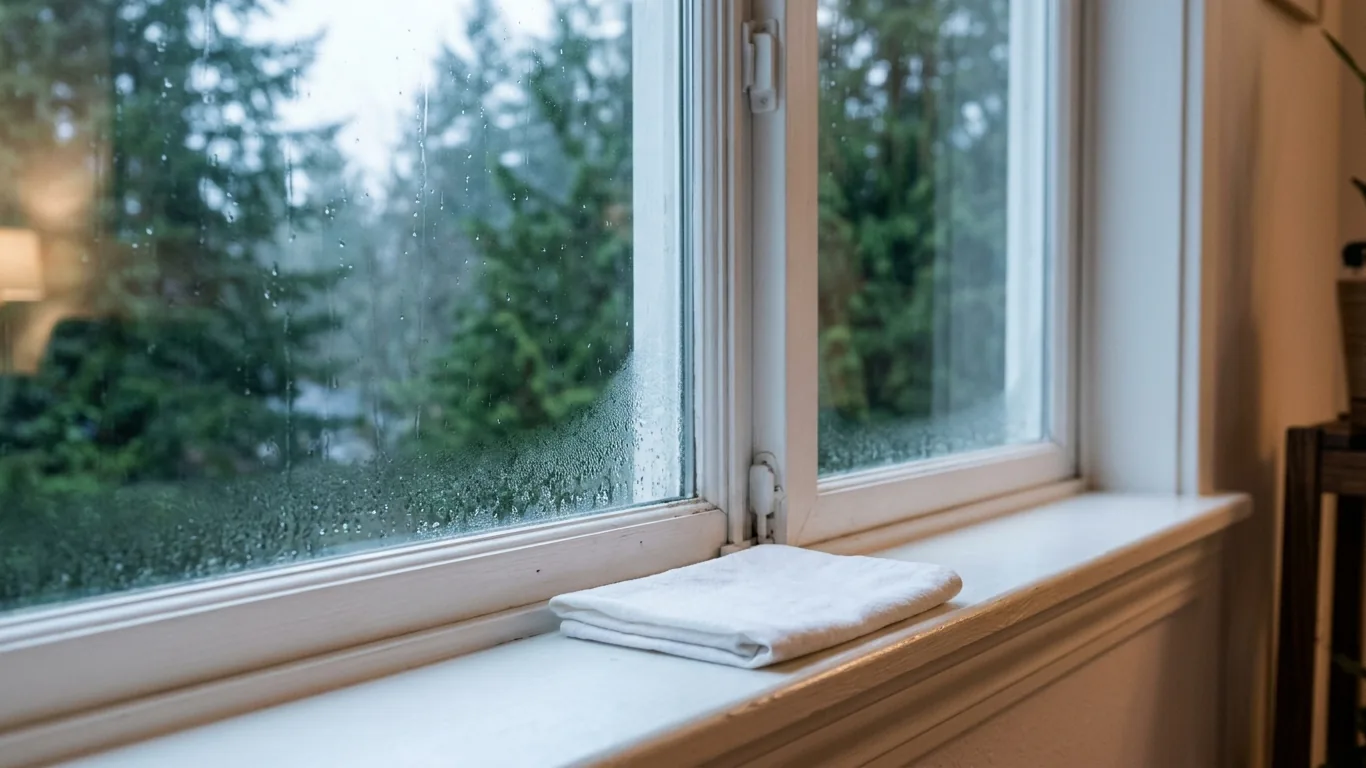
Why are my windows wet on the inside?
Condensation often forms in colder weather, when moist air inside the home comes into contact with cooler surfaces1. Glass is one of the places it shows: large differences between inside and outside temperatures can cause water to condense on windows7.
So does a wet window mean your house is too cold? The cold glass is where the water collects, but the thing to fix is the moisture. NRCan lists heavy condensation on windows as one of the signs of too much moisture in a home2. That's why this post works on the moisture and the airflow, not the thermostat.
Should you wipe condensation off windows?
Yes. Health Canada advises drying your window frames and sills daily, to keep water from dripping and causing mould to grow3. HealthLinkBC makes the same link: condensation on windows can lead to mould on frames or sills7.
Wipe the glass, then the frame and the sill. Run the cloth along the track too, so water doesn't sit there. Keeping a dry cloth by the windows that stream the most makes it a quick habit.
Wiping protects the frame and sill, but it doesn't lower the moisture in the air. If the windows are wet again the next morning, the moisture is still there. The next two sections deal with that.
How do I stop condensation on the inside of my windows?
There are two jobs: lower the moisture, and keep the air moving.
Lower the moisture
- Use the bathroom exhaust fan when you shower or bathe3.
- Run a dehumidifier if moisture is condensing on cold surfaces such as window panes3.
- Dry laundry in the dryer where you can: hanging wet laundry indoors can raise indoor humidity3.
- Unplug and put away humidifiers3.
- Aim for a relative humidity3 between 30% and 50%4. A humidity monitor (hygrometer) tells you where you are.
Keep the air moving
- Leave curtains and blinds open when you can. Heavy curtains or blinds can trap the cold and moisture and cause condensation on your windows3.
- Keep heating vents and baseboards clear of furniture, and leave interior doors open3. Air flowing across the glass helps keep it warmer, which is one reason heating vents and baseboard heaters sit beneath windows in many homes1.
- Pull furniture back from cold windows. Deep sills, closed drapes and blinds, and nearby furniture can block air movement and let cool air pool near a window1.
Keep the HRV on
If you have an HRV, make sure it's on1. It increases ventilation and helps reduce humidity2. Its filters are in the checklist below.
What can I put on my windows to prevent condensation?
What NRCan points to is the windows themselves: high-performance ENERGY STAR certified windows are more energy efficient and have less condensation than ordinary models1. That's a replacement decision, not a quick fix. For the windows you have now, the answer is the same as above: less moisture in the air and more air moving across the glass.
The wet-season moisture checklist
These are the parts of your home that move moisture out. Check each one as the wet months start. Most of these are homeowner jobs. We don't remove or wash bathroom exhaust fan covers, change furnace filters, clean HRV filters or clean dryer vents.
Bathroom exhaust fan
- Use it when you shower or bathe3, and keep the fan running after a shower3; Health Canada and HealthLinkBC give specific guidance7.
- Make sure it vents to the outside, not into the attic3.
- Before you clean it, turn the fan off and follow the maintenance instructions for your model11.
- Dust the fan blades periodically5 and vacuum the grille5.
- Check that the damper on the outside grille can open and close properly5. Do this from the ground only. If you can't see the vent from there, leave it for a qualified technician.
Range hood
Use the range hood every time you cook, preferably on the highest setting3; Pearly's deep and move-out cleans include range-hood filters, and our oven guide shows how to clean a range hood filter yourself.
Furnace filter
Health Canada says furnaces and their ductwork need regular maintenance, and that new air filters and periodic cleaning are essential to adequate furnace ventilation5. For how often to change your filter, follow your furnace's manual. Servicing the furnace and cleaning its ducts are jobs for a qualified technician.
HRV filter
CMHC says to clean or replace HRV filters every 2 months6, and Health Canada says they must be vacuumed or washed at least every second month5. Before any work on the unit, turn the HRV off and unplug it6. For the heat exchange core, check your owner's manual6. Health Canada also lists cleaning the core and the condensate drain and pan once a year5. If the ducts leading to and from the HRV need a more thorough cleaning, call an HRV service technician6.
Dryer lint trap and outside vent
Clean the lint tray every time you use the dryer3. Check that the dryer vents to the outside3. Inspect the outside exhaust vent routinely and clear any built-up lint3, and keep it clear of snow and foliage3. Check it from the ground only. Cleaning the duct between the dryer and the outside vent is a job for a qualified technician.
Window sills and tracks
While the windows are running wet, dry the frames and sills daily3, and wipe the tracks too. Our deep clean covers window sills and interior windows, including tracks and frames, so the season starts from clean. The drying between visits is still yours, though: a deep clean is a reset, not a substitute for wiping.
Victoria and the CRD: how wet the wet season gets
Here's what Environment and Climate Change Canada's 1991–2020 climate normals show8 for three Victoria weather stations9, as of October 202610.
- At the Victoria airport station, average precipitation is 146.0 mm in November, 146.1 mm in December and 155.3 mm in January, against 19.5 mm in July8.
- The airport averages 18.9 days with at least 0.2 mm of precipitation in November, 19.4 in December and 19.8 in January, against 5.4 in July8.
- December and January are the coldest months there, with daily average temperatures of 4.4 °C and 4.6 °C8.
- At the Gonzales9 and University stations, precipitation peaks in November10; at the airport, it peaks in January8.
At all8 three stations9, November to January are the three wettest months10. That wet stretch overlaps the coldest months8, and condensation often forms in colder weather1. These figures are for three Victoria stations, not the whole CRD.
Common mistakes that keep windows wet
- Wiping the glass but leaving the frames and sills wet. Dry them daily3; condensation can lead to mould on frames or sills7.
- Switching the bathroom exhaust fan off as soon as you're out of the shower. Keep it running after a shower; Health Canada3 and HealthLinkBC7 give specific guidance.
- A bathroom exhaust fan that vents into the attic. It should vent to the outside3.
- Closed curtains and blinds1, or furniture against the heating vents3.
- Drying laundry indoors, which can raise humidity3.
- Running a humidifier while the windows stream. Unplug it and put it away3.
- An HRV that's switched off1, or filters left longer than CMHC's every-2-months guidance6.
When to call a qualified technician
Some jobs on this list need a qualified technician: servicing the bathroom exhaust fan, the furnace or the HRV, and cleaning the dryer duct or the furnace ducts. The same goes for any outside vent you can't check from the ground.
Mould. Mould will typically grow indoors where moisture is present3, and HealthLinkBC says high humidity or indoor air moisture causes mould growth7. That's why everything above is about prevention. If you already see mould, go to the official guidance: Health Canada's guide to moisture and mould and HealthLinkBC's mould file cover cleaning a small area3 and when to get help7. For health questions, call HealthLinkBC at 8-1-1, or 7-1-1 for deaf and hard of hearing callers7.
What Pearly's does. Our cleans include dusting vent covers and ceiling fans, on recurring visits and in the deep clean. The deep clean also covers window sills and interior windows, including tracks and frames.
Related reading
Get your windows ready for the wet months
The wet months are here. Book a deep clean to reset the sills, tracks and interior windows, keep things steady through winter with recurring cleans, or get a free quote. We clean homes across Greater Victoria. For more seasonal guides, browse the blog.
Sources
- Natural Resources Canada (NRCan): Condensation. Accessed October 11, 2026.
- Natural Resources Canada (NRCan): Humidity levels: cooling and ventilating equipment. Accessed October 11, 2026.
- Health Canada: Guide to addressing moisture and mould indoors. Accessed October 11, 2026.
- Health Canada: Mould. Accessed October 11, 2026.
- Health Canada: Ventilation and the indoor environment. Accessed October 11, 2026.
- Canada Mortgage and Housing Corporation (CMHC): How to maintain a heat recovery ventilator. Accessed October 11, 2026.
- HealthLinkBC: Indoor air quality: Mould and other biological contaminants. Accessed October 11, 2026.
- Environment and Climate Change Canada (ECCC): Canadian Climate Normals 1991–2020: VICTORIA (AIRPORT) (a composite station: Climate ID 1018620 to 2013-07-10, then 1018621). Accessed October 11, 2026.
- Environment and Climate Change Canada (ECCC): Canadian Climate Normals 1991–2020: VICTORIA GONZALES (CITY), Climate ID 1018610. Accessed October 11, 2026.
- Environment and Climate Change Canada (ECCC): Canadian Climate Normals 1991–2020: VICTORIA (UNIVERSITY), Climate ID 1018598. Accessed October 11, 2026.
- Broan-NuTone: Spring Indoor Air Quality Checklist for a Healthier Home. Accessed October 11, 2026.